
English version see below
Kapitel 4 Auswirkungen der Gen-Injektion auf den Organismus
Um die Schäden der Impfung zu verstehen, muss man sich zunächst einmal anschauen, was nach der Injektion der Impfung im Körper geschieht.
Die modRNA, eingehüllt in LNP, wird in den Körper injiziert. Entgegen aller Behauptungen bleiben aber die LNP keineswegs am Ort der Injektion, sondern verteilen sich in sehr kurzer Zeit im ganzen Körper. Dadurch können in ebenfalls kurzer Zeit sämtliche Körperzellen mit modRNA “infiziert” werden. Genau genommen nennt man das Einbringen von genetischem Material in eine Körperzelle Transfektion.
Wenn die modRNA in der Zelle ist, macht sie das, was mRNA immer tut, sie überbringt den Bauplan in die zelleigenen Proteinfabriken (Ribosomen), und die Produktion von Spikeproteinen beginnt. Da wir schon gesehen haben, dass die modRNA eben danach nicht abgebaut werden kann (wegen N1-Methyl-Pseudouridin), wird damit eine dauerhafte, möglicherweise lebenslange Produktion von Spike-Proteinen induziert. Milliarden von Spikeproteinen werden nach der Bildung aus den Zellen geschleust und dem Organismus zur Verfügung gestellt.
Doch damit nicht genug. Eine Zelle, die von der modRNA befallen ist, “merkt”, dass etwas Unnormales stattfindet und sendet Hilferufe (Zytokine, Dangersignale) aus. Dies führt zu einer Aktivierung des Immunsystems, welches nun die Zelle angreift und zerstört. Da ja zumindest theoretisch alle Körperzellen befallen sein können, führt dies zu einer dauerhaften Aktivierung des Immunsystems und zu einem globalen Angriff auf körpereigene Zellen, also zu einer Autoimmunsituation, da Autoimmunerkrankungen ja dadurch definiert sind, dass körpereigene Zellen angegriffen werden. Die einzige Möglichkeit, die Produktion der Spikeproteine zu unterbinden, scheint also der Angriff auf die Zelle und die Zerstörung der Zelle zu sein.
Einige Studien weisen noch auf weitere Gefahren hin.
So wurde in einer Studie eine “transkriptionelle Dysregulation” als Folge der modRNA-Impfung beschrieben. Mit Transkriptom bezeichnet man die Summe aller aktuell von der DNA abgelesenen RNA in einer Zelle.
Zur Erinnerung: In einem gesunden Organismus werden Proteine über das Ablesen der mRNA in den Ribosomen hergestellt. Die mRNA bekommt ihre Informationen aber aus unserem Erbgut, der DNA, in dem die mRNA ein Spiegelbild der Teile der DNA ist, die für die Kodierung des Proteins zuständig sind.
Eine diesbezügliche Dysfunktion beschreibt jetzt den Zustand, wenn die DNA zu mRNA Übersetzung nicht mehr regelrecht funktioniert, die mRNA also nicht mehr das Spiegelbild der DNA ist. Da die mRNA in den Ribosomen abgelesen wird, um dort Proteine zu produzieren, ist leicht erkennbar, dass damit Nonsens-Proteine gebildet werden, also Proteine ohne Nutzen für den Organismus, wie ich ja weiter oben schon erwähnt hatte.
Welche Schäden diese Nonsens-Proteine dann im Körper anrichten, kann man nur erahnen. Eine mögliche Folge werden Amyloide sein, die ja bekanntlich wesentlich an der Entstehung von Demenz und Alzheimer beteiligt sind. Weiter deutet dies auf anhaltende zelluläre Stressreaktionen, mitochondriale Dysfunktion und Immundysregulation nach Exposition gegenüber mRNA-Impfstoffen hin. Auch eine beschleunigte Entstehung von Krebs lässt sich so erklären.
Als Folge kommt es gemäß einer weiteren Studie dazu, dass es zu Verschiebungen bestimmter Proteine kommt, die nachweisbar sind, z. B in einem Anstieg von NT-proBNP (Herzinsuffizienz-Marker), CRP und Ferritin (akut-Phase-Proteine, Entzündungsmarker).
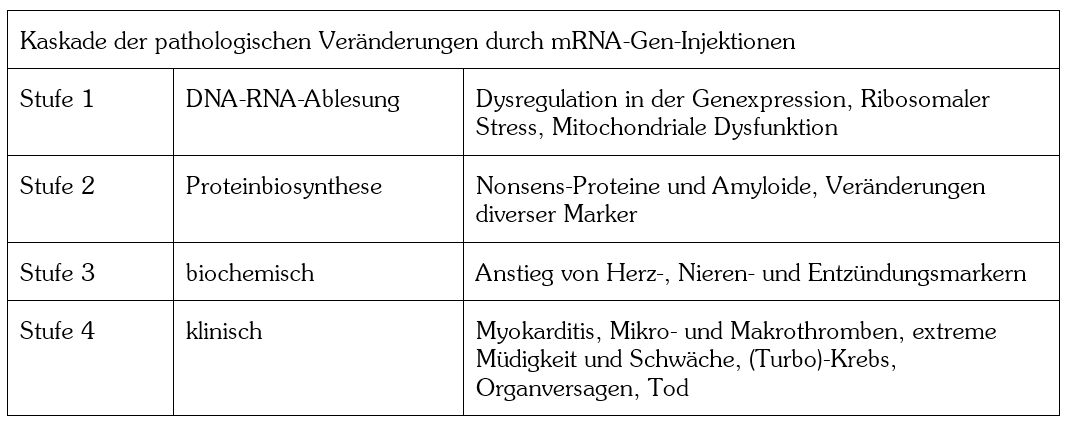
Dies führt insgesamt zu einer Kaskade von Veränderungen, die zu schweren Schäden im Organismus eines Menschen führen können.
In der Stufe 1 sehen wir also die Dysregulation von tausenden von Genen, teilweise durch deren falsches Ablesen, mit der Folge der Störung der Ribosomen, die Nonsens-Proteine herstellen, sowie einen zunehmenden Zusammenbruch der Mitochondrien, die verantwortlich für die Energieproduktion in unserem Körper sind, wodurch die tägliche Leistungsfähigkeit dramatisch absinken kann – bis zur dauerhaften Bettlägerigkeit.
In der Stufe 2 der Kaskade wird der Körper in seiner grundlegenden Ebene destabilisiert, die Proteine sind falsch gefaltet (Amyloide), sind verändert, z. B. bei Fibrinogen, Aktin und anderen, was zu Störungen der Blutgerinnung, chronischem Gewebestress und Entzündungen führt.
In der Stufe 3 zeigen sich die Auswirkungen in der Blutchemie mit Anstieg diverser Marker, die eine Herzbelastung, Nierenfunktionsstörungen, chronische Entzündungen und Überaktivierungen des Immunsystems anzeigen, was in Stufe 4 dann klinisch manifest wird durch z. B.
Myokarditis und Perikarditis
Hyperkoagulabilität und Gerinnungsstörungen
Tiefe Erschöpfung und Immundysregulation
Turbo-Krebserkrankungen
Tod
Und vieles mehr…
Die Kaskade, die mit einem versteckten molekularen Chaos beginnt, endet somit in einer sichtbaren Erkrankung und schlimmstenfalls dem Verlust des Lebens.
Unterschiede zwischen Infektion, Injektion und Shedding
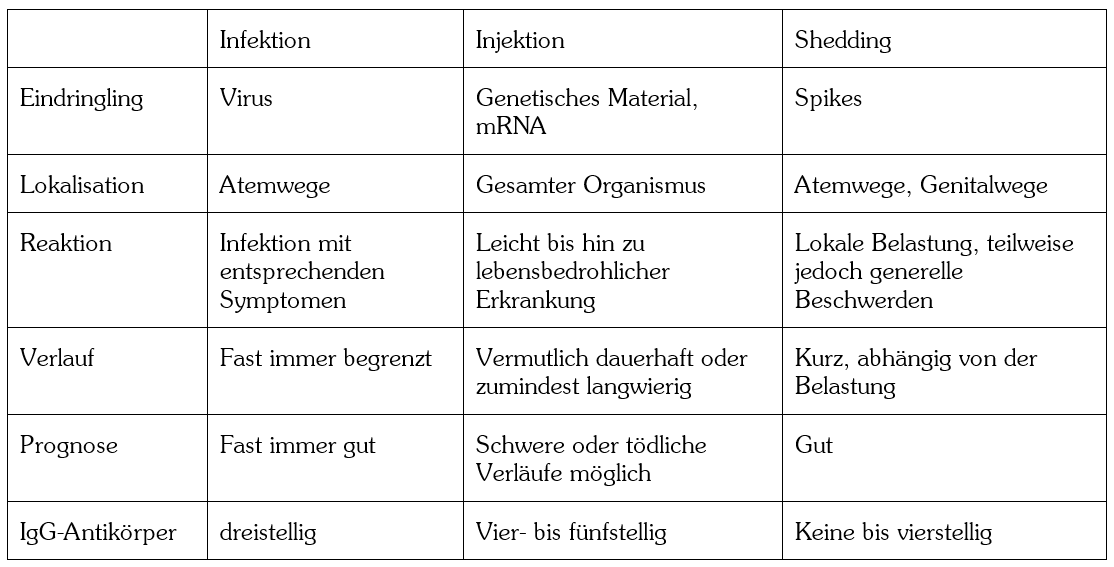
Was ist eigentlich der Unterschied zwischen Infektion, Injektion und Shedding? Verlaufen die Erkrankungen ähnlich? Dies werde ich immer wieder in meiner Praxis gefragt.
Nun, grundsätzlich ist allen drei Ereignissen das Spikeprotein gemeinsam, somit sind grundsätzlich die gleichen Symptome und Veränderungen im Körper möglich. Aber mit himmelweiten Unterschieden.
Schauen wir uns die Mechanismen der drei möglichen Ereignisse nochmals kurz an.
Infektion
Bei Atemwegsinfektionen, zu denen ja auch die Corona-Infektion gehört, werden die Erreger eingeatmet. Sie gelangen auf die Schleimhaut der oberen Atemwege, also Nasen, Rachen und obere Bronchien. Hier treffen Sie auf Schleimhautzellen und versuchen, in diese einzudringen, wozu das Spike notwendig ist, da es den Schlüssel zum Öffnen der Zelltüre der Schleimhautzellen darstellt.
Spätestens ab diesem Moment wird ein biochemischer Alarm ausgelöst, und unser Abwehrsystem reagiert. Auf den Schleimhäuten sind das vor allem die IgA-Antikörper, die in Aktion treten und die Infektion schon sehr früh bekämpfen. Während die Viren versuchen, in die Zellen zu gelangen, beginnt die Abwehr bereits mit den Gegenmaßnahmen. Das löst Symptome aus, und je nach Befall kommt es zu Schnupfen, Halsschmerzen oder Husten.
Sicher werden die Viren in eine ganze Reihe von Schleimhautzellen eindringen, dort die Neuproduktion von Viren ankurbeln, in dem ihre Erbsubstanz, nämlich mRNA in die Zellen gelangt und die Ribosomen mit der Produktion starten. Es werden hier aber nicht nur Spikes, sondern ganze Viren hergestellt, die dann z. B. mit dem Husten aus dem Körper ausgestoßen werden.
Ist unsere Abwehr gut drauf, dauert das nur einige Tage, und die Symptome schwächen sich bald ab. In diesem optimalen Fall gelangen keine oder nur sehr wenige Viren ins Blut, so dass außerhalb der Schleimhautzellen, wenn überhaupt, nur wenige Zellen im Körper befallen werden und Schaden nehmen können. Dieser optimale Fall ist die Regel und dürfte bei 99% der Infektionen so sein. Nur in einem kleinen Teil kommt es zu einer systemischen Reaktion des Körpers und damit zu Organschäden, auch eine Herzmuskelentzündung (Myokarditis) ist dann beispielsweise möglich.
„Impfung“
Hier wird unter Umgehung der Schleimhautbarriere genetisches Material direkt in den Körper gespritzt, bereits nach 15 bis 30 Minuten hat sich der Inhalt im ganzen Körper verteilt und kann die Zellen befallen. Folge ist die kurz danach eintretende massive Produktion von Spikeproteinen im ganzen Körper mit einer in der Folge entstehenden möglicherweise dauerhaften Immunreaktion mit allen Konsequenzen, die in Kapitel 5 detailliert beschrieben werden. Im Unterschied zur Infektion wird der Körper zwar nur mit Spikeproteinen geflutet, dafür aber massenhaft, ich schätze die Dimension millionenfach höher ein. Demzufolge ist auch das Schadenspotenzial dramatisch größer.
Shedding
Es ist inzwischen belegt, dass Spikeproteine durch Exosomen transportiert werden können. Exosomen sind körpereigene Ausstülpungen der Zellwand, in dem sich aus der Zellwand ein kleines Tröpfchen löst. Diese Vesikel sind sehr klein, haben aber einen Inhalt, der von Zelle zu Zelle weitergegeben werden kann. In gewisser Weise dienen sie damit der Kommunikation zwischen Zellen.
Diese Exosomen können auch Spikeproteine enthalten, und sie können ausgeatmet werden. Dadurch ist es möglich, dass andere Menschen diese einatmen. In diesem Fall passiert das Gleiche wie bei einer Infektion, die Exosomen bekommen Kontakt mit den Schleimhautzellen des Empfängers, können dort eine Reaktion auslösen, und da das Spike ja der Schlüssel zur Zelle ist, in die Zelle eindringen.
Jedoch haben Spikes kein genetisches Material, sie können somit keine Produktion neuer Spikes auslösen, sondern werden vermutlich in der Zelle abgebaut.
Somit sollte Shedding eigentlich ein vernachlässigbares Problem darstellen, jedoch kenne ich Menschen, die bei intensiverem Kontakt zu (frisch?) Geimpften mit körperlichen Symptomen reagieren. Berichtet wurden z. B. Schweißausbrüche, Herzrasen, sowie bei Frauen gynäkologische Beschwerden und Menstruationsstörungen insbesondere dann, wenn sie regelmäßig den Exosomen eines Geimpften, z. B. dem Ehemann, ausgesetzt sind.
Der genaue Mechanismus ist mir nicht bekannt, aber Spikes können auch im Schweiß oder in der Ejakulationsflüssigkeit vorhanden sein, wobei im letzteren Falle das Eindringen über das weibliche Genitale bis in die Gebärmutter möglich ist.
Ich kenne auch einen Fall aus meiner Praxis, wo umgekehrt der ungeimpfte Ehemann, völlig ohne Beschwerden, einfach wissen wollte, ob er über seine geimpfte Frau Spikes in seinem Körper habe, und zu meiner Überraschung hatte ich hier den höchsten jemals in meiner Praxis gemessenen Wert an freien Spikes im Blutserum – ohne jede symptomatische Reaktion oder Erkrankung! In diesem Fall waren möglicherweise die Spikes doch in den Körper gelangt, was aber spekulativ ist, da theoretisch auch eine alte Infektion oder Persistenz von Viren im Darm die Ursache sein könnten. Weiter untersucht haben wir das nicht, da keine Krankheitssymptome vorlagen.
Zusammenfassung
Es ist geplant, ca. ein bis zweimal pro Woche ein neues Kapitel zu diesem Lehrbuch zu veröffentlichen, soweit es meine Zeit erlaubt. Es wird jeweils auf meinem deutschen Telegram-Kanal https://t.me/coronawissenschaft angekündigt.
Bleiben Sie neugierig
Teil 1 des Lehrbuchs finden sie hier: https://ralftillenburg.substack.com/p/lehrbuch-zur-behandlung-von-schaden
Chapter 4 Effects of gene injection on the organism
To understand the damage caused by vaccination, we must first look at what happens in the body after the vaccine is injected.
The modRNA, encased in LNP, is injected into the body. Contrary to all claims, however, the LNP does not remain at the injection site, but spreads throughout the body in a very short time. As a result, all body cells can be ‘infected’ with modRNA in a similarly short time. Strictly speaking, the introduction of genetic material into a body cell is called transfection.
Once the modRNA is in the cell, it does what mRNA always does: it delivers the blueprint to the cell’s own protein factories (ribosomes), and the production of spike proteins begins. Since we have already seen that modRNA cannot be broken down afterwards (due to N1-methylpseudouridine), this induces a permanent, possibly lifelong production of spike proteins. Billions of spike proteins are released from the cells after formation and made available to the organism.
But that’s not all. A cell infected by the modRNA ‘notices’ that something abnormal is happening and sends out distress signals (cytokines, danger signals). This leads to the activation of the immune system, which now attacks and destroys the cell. Since, at least in theory, all body cells can be infected, this leads to permanent activation of the immune system and a global attack on the body’s own cells, i.e. to an autoimmune situation, since autoimmune diseases are defined by the fact that the body’s own cells are attacked. The only way to stop the production of spike proteins therefore seems to be to attack and destroy the cell.
Some studies point to further dangers.
For example, one study described ‘transcriptional dysregulation’ as a consequence of modRNA vaccination. Transcriptome refers to the sum of all RNA currently read from DNA in a cell.
As a reminder, in a healthy organism, proteins are produced by reading the mRNA in the ribosomes. However, the mRNA obtains its information from our genetic material, the DNA, in which the mRNA is a mirror image of the parts of the DNA that are responsible for encoding the protein.
A dysfunction in this regard now describes the state in which DNA to mRNA translation no longer functions properly, meaning that the mRNA is no longer a mirror image of the DNA. Since the mRNA is read in the ribosomes in order to produce proteins there, it is easy to see that this results in the formation of nonsense proteins, i.e. proteins that are of no use to the organism, as I mentioned above.
One can only guess at the damage these nonsense proteins then cause in the body. One possible consequence will be amyloids, which are known to play a significant role in the development of dementia and Alzheimer’s disease. Furthermore, this points to persistent cellular stress responses, mitochondrial dysfunction and immune dysregulation after exposure to mRNA vaccines. It also explains the accelerated development of cancer.
According to another study, this results in detectable shifts in certain proteins, e.g. an increase in NT-proBNP (heart failure marker), CRP and ferritin (acute phase proteins, inflammation markers).
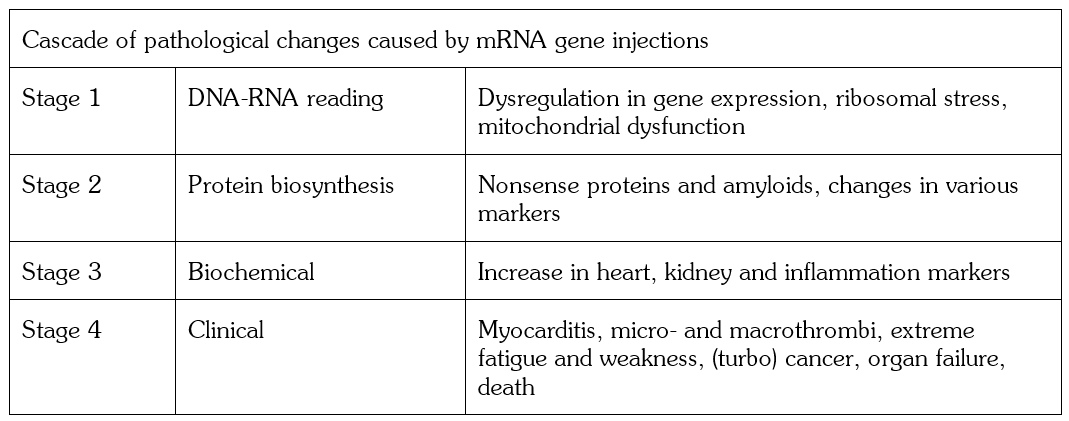
Overall, this leads to a cascade of changes that can cause serious damage to the human organism.
In stage 1, we see the dysregulation of thousands of genes, partly due to their incorrect reading, resulting in the disruption of ribosomes that produce nonsense proteins, as well as an increasing breakdown of the mitochondria, which are responsible for energy production in our body, which can dramatically reduce daily performance – to the point of permanent bedriddenness.
In stage 2 of the cascade, the body is destabilised at a fundamental level, proteins are misfolded (amyloids) and altered, e.g. fibrinogen, actin and others, leading to blood clotting disorders, chronic tissue stress and inflammation.
In stage 3, the effects are evident in the blood chemistry with an increase in various markers indicating cardiac stress, renal dysfunction, chronic inflammation and overactivation of the immune system, which then manifests clinically in stage 4, e.g.
Myocarditis and pericarditis
Hypercoagulability and coagulation disorders
Profound exhaustion and immune dysregulation
Turbo cancers
Death
And much more...
The cascade that begins with hidden molecular chaos thus ends in visible disease and, in the worst case, loss of life.
Differences between infection, injection and shedding
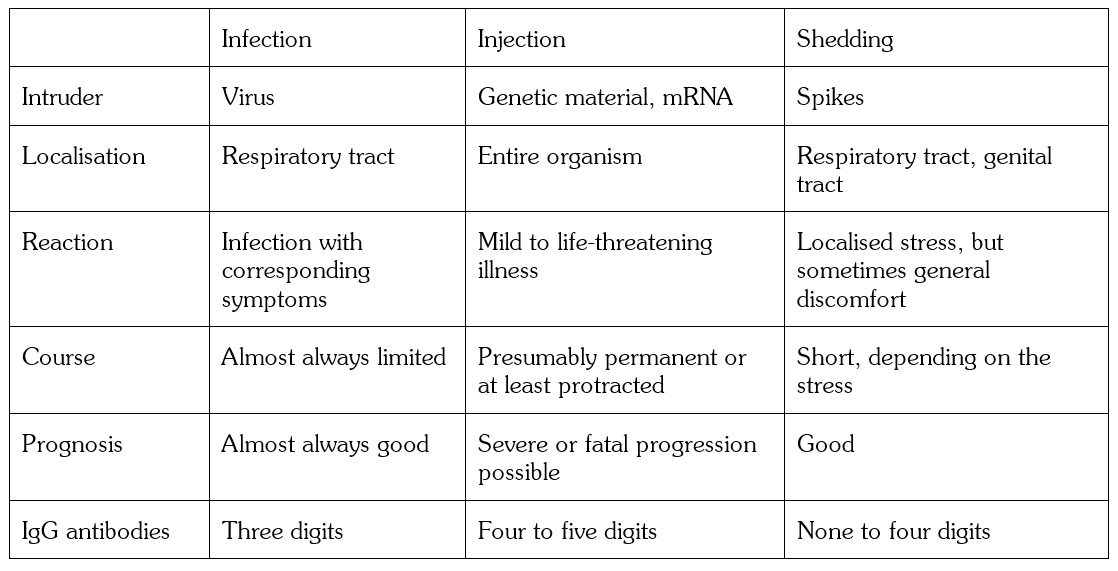
What is the difference between infection, injection and shedding? Do the diseases progress in a similar way? I am asked this question time and time again in my practice.
Well, basically, all three events have the spike protein in common, so basically the same symptoms and changes in the body are possible. But with huge differences.
Let’s take another quick look at the mechanisms of the three possible events.
Infection
In respiratory infections, which include coronavirus infection, the pathogens are inhaled. They reach the mucous membranes of the upper respiratory tract, i.e. the nose, throat and upper bronchi. Here they encounter mucosal cells and attempt to penetrate them, for which the spike is necessary, as it is the key to opening the cell doors of the mucosal cells.
At this point, at the latest, a biochemical alarm is triggered and our immune system responds. On the mucous membranes, it is primarily the IgA antibodies that spring into action and fight the infection at a very early stage. While the viruses try to enter the cells, the immune system already begins to take countermeasures. This triggers symptoms, and depending on the infection, these can include a runny nose, sore throat or cough.
The viruses will certainly penetrate a whole series of mucous membrane cells, where they will stimulate the production of new viruses by introducing their genetic material, namely mRNA, into the cells and causing the ribosomes to start production. However, it is not only spikes that are produced here, but entire viruses, which are then expelled from the body, for example, when coughing.
If our immune system is in good shape, this only takes a few days and the symptoms soon subside. In this optimal case, no or very few viruses enter the bloodstream, so that outside the mucous membrane cells, if at all, only a few cells in the body are affected and can be damaged. This optimal case is the rule and is likely to be the case in 99% of infections. Only in a small number of cases does the body have a systemic reaction, leading to organ damage; for example, inflammation of the heart muscle (myocarditis) is then possible.
‘Vaccination’
Here, genetic material is injected directly into the body, bypassing the mucosal barrier. After just 15 to 30 minutes, the content has spread throughout the body and can infect the cells. The result is the massive production of spike proteins throughout the body shortly afterwards, with a potentially permanent immune response and all the consequences described in detail in Chapter 5. In contrast to infection, the body is flooded with spike proteins, but on a massive scale, which I estimate to be millions of times greater. As a result, the potential for damage is also dramatically greater.
Shedding
It has now been proven that spike proteins can be transported by exosomes. Exosomes are the body’s own protrusions of the cell wall, in which a small droplet detaches from the cell wall. These vesicles are very small, but their contents can be passed from cell to cell. In a sense, they serve as a means of communication between cells.
These exosomes can also contain spike proteins, and they can be exhaled. This makes it possible for other people to inhale them. In this case, the same thing happens as with an infection: the exosomes come into contact with the recipient’s mucosal cells, where they can trigger a reaction, and since the spike is the key to the cell, they can penetrate the cell.
However, spikes do not contain genetic material, so they cannot trigger the production of new spikes, but are presumably broken down in the cell.
Thus, shedding should actually be a negligible problem, but I know people who react with physical symptoms when they have intensive contact with (recently?) vaccinated individuals. For example, sweating, palpitations, and, in women, gynaecological complaints and menstrual disorders have been reported, especially when they are regularly exposed to the exosomes of a vaccinated person, e.g. their husband.
I am not familiar with the exact mechanism, but spikes can also be present in sweat or ejaculate, in which case they can enter the uterus via the female genitals.
I also know of a case from my practice where, conversely, the unvaccinated husband, who had no symptoms whatsoever, simply wanted to know whether he had spikes in his body via his vaccinated wife, and to my surprise, I found the highest level of free spikes in blood serum ever measured in my practice – without any symptomatic reaction or illness! In this case, the spikes may have entered the body after all, but this is speculative, as theoretically an old infection or persistence of viruses in the intestine could also be the cause. We did not investigate this further as there were no symptoms of illness.
Summary
I plan to publish a new chapter of this textbook approximately once or twice a week, time permitting. Each new chapter will be announced on my German Telegram channel https://t.me/coronawissenschaft.
Stay curious
Part 1 of the textbook can be found here: https://ralftillenburg.substack.com/p/lehrbuch-zur-behandlung-von-schaden
Inwieweit sind Ihre wissenschaftlichen Erkenntnisse eingegangen in die „Mainstream Wissenschaft“?