
English version see below
Kapitel 3 Inhaltsstoffe der Gen-Injektion
mRNA
Nun ist es nicht so einfach, genetisches Material in den menschlichen Körper zu bekommen, welches dann auch in der Lage ist, die Zellen zur Spikeproduktion zu bringen. Das dazu notwendige genetische Material ist mRNA. Da RNA recht kurzlebig ist und im Organismus zügig abgebaut wird, muss dieses Molekül in irgendeiner Form haltbar gemacht werden. Um es in Zellen zu bringen, denn nur dort findet die Proteinbiosynthese (Herstellung von Eiweiß) statt, benötigt man zusätzlich noch ein Transportmittel.
RNA (zu Deutsch RNS) steht für Ribonukleinsäure, das “m” ist die Abkürzung für “Messenger” = Nachricht, Botschaft. Der Körper stellt ständig individuelle mRNA her, die er für Nachrichten innerhalb einer Zelle nutzt.
RNA besteht grundsätzlich nur aus vier Bausteinen, die über einen Zucker, die Ribose, und eine Phosphatgruppe aneinander gekettet sind. Diese Bausteine sind Cytosin, Adenin, Guanin und Uracil, abgekürzt C, A, G und U im folgenden Bild (Quelle: Wikipedia):
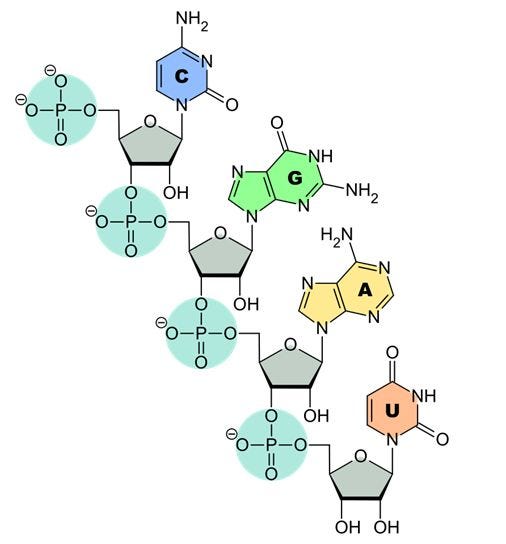
Verknüpfung der Nukleinbasen (C, G, A und U) über ein Zucker- (grau) und Phosphatrückgrat (türkis) zur RNA
Die Reihenfolge der vier Basen G, C, A und U ist wechselnd, da mit ihnen so eine Art Programmiercode ermöglicht wird. Jeweils drei Basen stehen für eine Aminosäure, so steht zum Beispiel die Folge U-C-C für eine andere Aminosäure als C-U-A. Um nun ein Eiweiß (Protein) zu programmieren, setzt man einfach die Dreierpaare der Basen hintereinander in die mRNA, diese wird dann in den Proteinfabriken, den Ribosomen der Zelle, ausgelesen und damit ein Protein hergestellt. Dies geschieht in unserem Körper tagaus tagein in millionenfacher Menge. Die Reihenfolge dieser Basen für die Programmierung der Proteine wird in der Regel über unsere Gene bestimmt. Die Gene werden ausgelesen, dadurch entsteht die mRNA, was dann zur Produktion des Proteins führt.
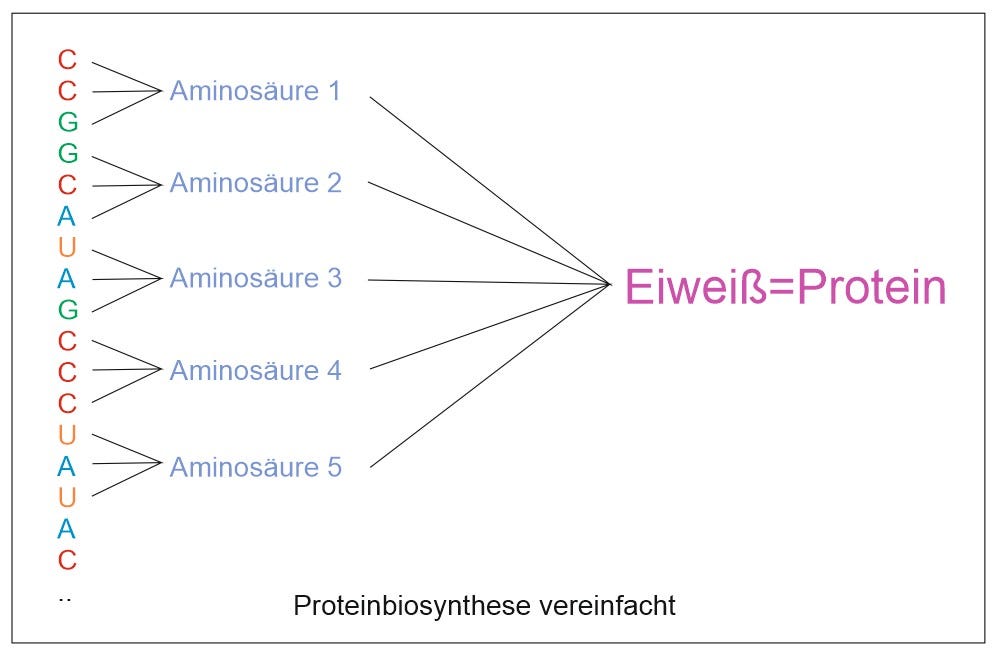
Im Schaubild sehen Sie vereinfacht die Proteinbiosynthese in den Ribosomen. Bedingt dadurch, dass je 3 Basen eine Aminosäure kodieren, ist es also sehr wichtig, mit dem Ablesen an der richtigen Stelle zu beginnen. Denn wenn man nur um eine Base zu spät abliest, kommt ein ganz anderes Protein heraus, da andere Aminosäuren produziert werden. Im folgenden Bild wurde nicht mit den obersten „C“ (Cytosin) das Ablesen begonnen, sondern erst mit den zweiten „C“ darunter,
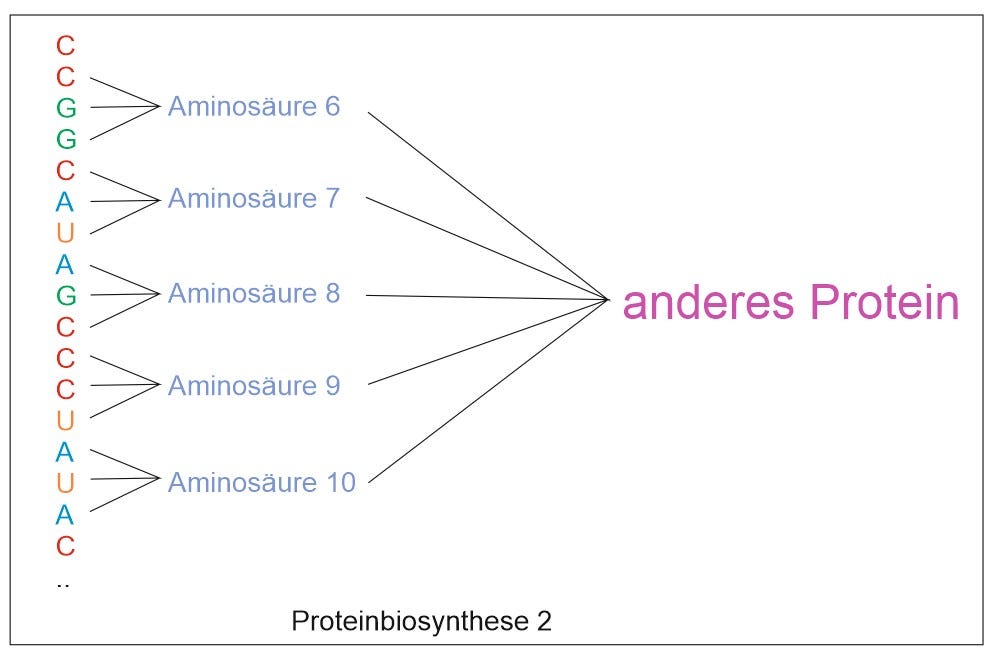
Durch die jetzt anderen Dreierkombinationen entstehen natürlich Codes für andere Aminosäuren und dadurch auch andere Proteine. Die Frage ist, ob solche anderen Proteine dann im Körper bekannt sind und also sinnvoll sind für unseren Stoffwechsel. Und genau hier liegt ein großes Problem, denn es entstehen dann Nonsens-Proteine, mit denen der Körper nichts anfangen kann, die im harmlosen Fall einfach nichts bewirken, abgebaut werden, im weniger harmlosen Fall aber unseren Stoffwechsel massiv stören, Gifte bilden lassen oder zu Amyloiden (fehlgefaltete Proteine) werden, die dann z. B. Krankheiten, wie Alzheimer und andere auslösen können.
Wie schafft der gesunde Körper es, solche Fehler zu vermeiden? Zum Beispiel dadurch, dass er eine Startsequenz und eine Stoppsequenz in diese RNA einbaut. Die Startsequenz ist zum Beispiel A-U-G und für die Ribosomen bedeutet das, dass unmittelbar danach das Auslesen der Triple beginnt. So ist gesichert, dass es nicht oder nur selten zu Fehlern kommt.
Insgesamt ist das alles noch deutlich komplizierter, und es gibt nicht nur mRNA, sondern auch noch viele andere RNA, z. B. siRNA oder asRNA, aber für das Verständnis der Wirkung der mRNA-Impfungen sollte dies reichen.
Ein großes Problem für die Impfindustrie: Wie mache ich mRNA so lange haltbar, dass sie mindestens so lange existiert, bis sie aus der Spritze in die Zelle gelangt ist, um dort die Spikeproduktion zu starten und möglichst lange zu unterhalten? Und wie kommt die mRNA überhaupt in die Zelle herein?
Wie schon beschrieben, wird die mRNA nach dem Auslesen abgebaut, damit ein Protein nicht unendlich oft hergestellt wird. Um die mRNA haltbar zu machen, hat man zur Herstellung der Impfstoffe einen Baustein der mRNA, nämlich Uridin (= Uracil plus Zucker, siehe Bild oben), durch ein ähnliches Molekül, nämlich N1-Methyl-Pseudouridin ersetzt.
Durch diesen einfachen Schritt konnten die Enzyme, die üblicherweise mRNA nach Nutzung abbauen, nicht mehr funktionieren. Die mRNA war jetzt verändert, so dass man konsequenterweise nicht mehr von mRNA, sondern von modRNA, also modifizierter RNA sprechen sollte. Diese war jetzt so haltbar, dass es Menschen gibt, bei denen man über ein Jahr nach der Impfung immer noch modRNA im Körper nachweisen kann.
Ist Ihnen aufgefallen, dass der Name einer der Hersteller der Impfbrühe dies in seinem Namen trägt? Mode RNA = Moderna!
Das zweite Problem des Ersetzens durch N1-Methyl-Pseudouridin ist, dass dieses durch die Ribosomen nicht mehr ausgelesen werden kann, Bei Ablesen der Triple wird dann das Pseudouridin einfach überschlagen, und das Ablesen geht danach weiter. Man nennt das Frame-Shifting, und eine Studie hat gezeigt, dass dies tatsächlich passiert. Auch das führt dann zu falschen Proteinen, die dem Körper schaden können.
Diese modRNA, die über die Gen-Injektion in den Körper und in die Zelle gelangt, führt also in den Ribosomen (Proteinfabriken) wegen der langen Haltbarkeit zur massenhaften Herstellung von Spike-Proteinen. Wenn man das verstanden hat, erkennt man auch schnell, dass man diese Impfung nicht ausleiten kann, da es sich hier um eine genetische Manipulation handelt. Wann immer Ihnen ein „Heilkundiger“ anbietet, diese Impfung auszuleiten, sollten sie die Flucht ergreifen, denn es ist offensichtlich, dass dieser „Heikundige“ das Prinzip der Gen-Injektion nicht verstanden hat. Machen sie auch einen Bogen um „Ausleitungsfortbildungen“ oder „Ausleitungskongresse“. All das hat mit Wissenschaft nichts zu tun!
Leider gibt es deutliche Hinweise, dass diese modRNA auch unsere Gene verändern kann, wobei die dann möglichen Auswirkungen auf unseren Organismus noch gar nicht vollumfänglich überblickt werden können.
Lipid-Nanopartikel (LNP)
Um die modRNA durch die Zellwand in das Zellinnere zu bekommen, setzte man kleine Fettkügelchen ein. Da die Zellwand ja überwiegend aus Fetten besteht, war es somit möglich, dass die Fettkügelchen mit der Zellwand verschmelzen und damit den Inhalt, nämlich die modRNA in das Zellinnere freigeben. Diese Fettkügelchen sind die sogenannten Lipid-Nanopartikel, kurz LNP. Leider hat man da (Absicht?) äußerst giftige Versionen gewählt, die zum einen bis dahin für die Anwendung am Menschen überhaupt nicht zugelassen waren und deren Auswirkungen auf den Organismus bisher nicht einmal vernünftig und komplett untersucht wurden. Gesichert ist bisher, dass die LNP der Gen-Injektion schwere Entzündungen im Körper auslösen können.
Sonstige Inhaltsstoffe
Neben modRNA und LNP hat man aber inzwischen noch weitere Inhaltsstoffe in der Gen-Injektion festgestellt, die nicht deklariert sind und offiziell in einer solchen Impfung auch nichts zu suchen haben, z. B. DNA.
DNA (deutsch DNS) steht für Desoxyribonukleinsäure und ist ebenfalls genetisches Material, aber deutlich länger haltbar, damit auch deutlich gefährlicher. Es ist bisher nicht bekannt und untersucht, welche Konsequenzen dies für den Organismus haben wird. Diese DNA stammt von den Bakterien, die zur Herstellung der modRNA benutzt wurden, in dem man diese Bakterien genetisch verändert hat. Bei der “Ernte” der modRNA aus der Bakterien-modRNA-Suppe hat man aber dann die DNA der Bakterien bzw. Teilabschnitte davon nicht ausreichend entfernt. Welche Auswirkungen das auf den menschlichen Organismus hat, inklusive Genveränderung oder Krebsentstehung, ist bisher nicht ausreichend bekannt. Es ist grundsätzlich jedenfalls möglich, dass sich diese Fremd-DNA mit unserem eigenen Erbgut, welches ja auch aus DNA besteht, verbindet und damit unsere Gene quasi umprogrammiert werden.
Inzwischen sind noch zahlreiche weitere undeklarierte Stoffe in den diversen Impfungen gegen Corona gefunden worden, deren Auswirkungen auf den Organismus völlig unbekannt sind.
Es ist geplant, ca. ein bis zweimal pro Woche ein neues Kapitel zu diesem Lehrbuch zu veröffentlichen, soweit es meine Zeit erlaubt. Es wird jeweils auf meinem deutschen Telegram-Kanal https://t.me/coronawissenschaft angekündigt.
Bleiben Sie neugierig
Teil 1 des Lehrbuchs finden sie hier: https://ralftillenburg.substack.com/p/lehrbuch-zur-behandlung-von-schaden
Chapter 3 Ingredients of gene injection
mRNA
Now, it is not so easy to get genetic material into the human body that is then also capable of causing the cells to produce spikes. The genetic material required for this is mRNA. Since RNA is quite short-lived and is rapidly broken down in the organism, this molecule must be preserved in some form. In order to get it into cells, because that is the only place where protein biosynthesis takes place, an additional means of transport is required.
RNA stands for ribonucleic acid, with the ‘m’ being short for ‘messenger’. The body constantly produces individual mRNA, which it uses for messages within a cell.
RNA basically consists of only four building blocks that are linked together via a sugar, ribose, and a phosphate group. These building blocks are cytosine, adenine, guanine and uracil, abbreviated C, A, G and U in the following image (source: Wikipedia):
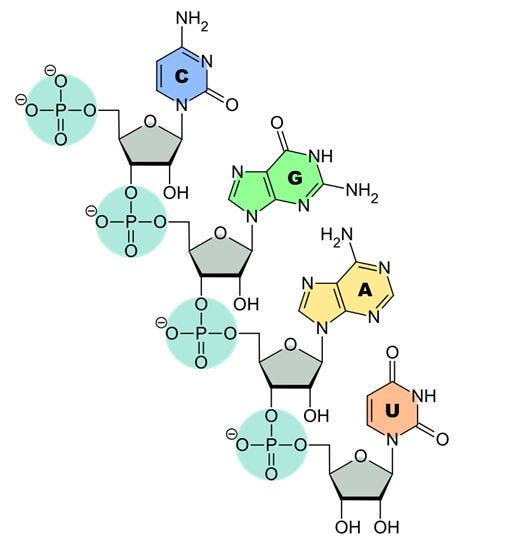
Linking of the nucleic bases (C, G, A and U) via a sugar (grey) and phosphate backbone (turquoise) to form RNA
The order of the four bases G, C, A and U varies, as this enables a kind of programming code. Three bases represent one amino acid, so for example the sequence U-C-C represents a different amino acid than C-U-A. To programme a protein, the triplets of bases are simply placed one after the other in the mRNA, which is then read in the protein factories, the ribosomes of the cell, and a protein is produced. This happens in our bodies day in, day out, millions of times over. The sequence of these bases for programming proteins is usually determined by our genes. The genes are read, which produces mRNA, which then leads to the production of the protein.
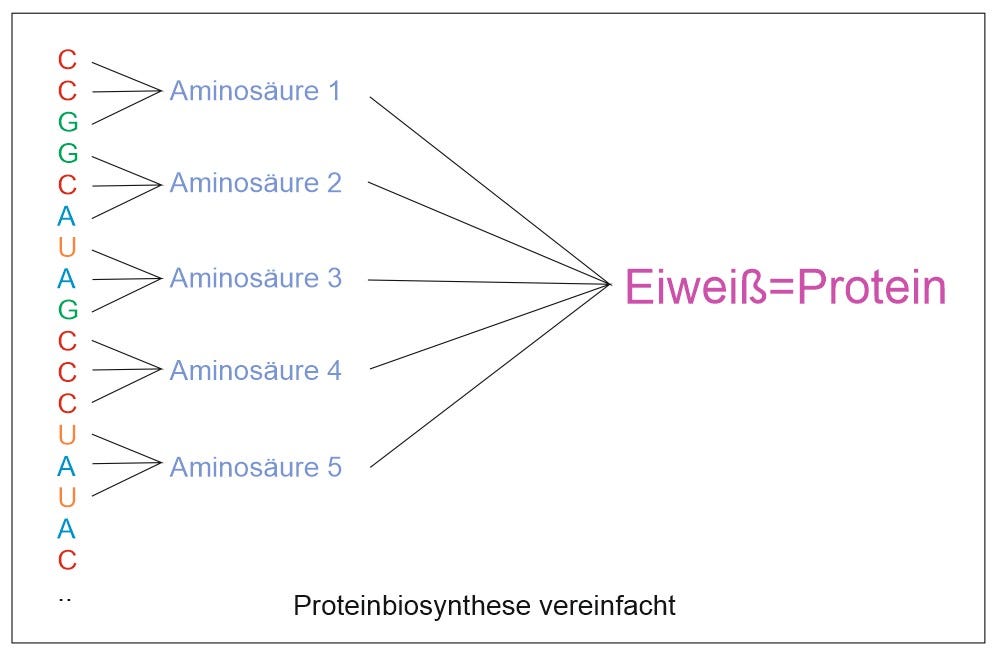
Protein biosynthesis simplified, Aminosäure = amino acid
The diagram shows a simplified version of protein biosynthesis in the ribosomes. Due to the fact that every 3 bases code for one amino acid, it is very important to start reading at the right place. If you read just one base too late, a completely different protein will be created because different amino acids will be produced. In the following image, reading did not begin with the top ‘C’ (cytosine), but with the second ‘C’ below it.
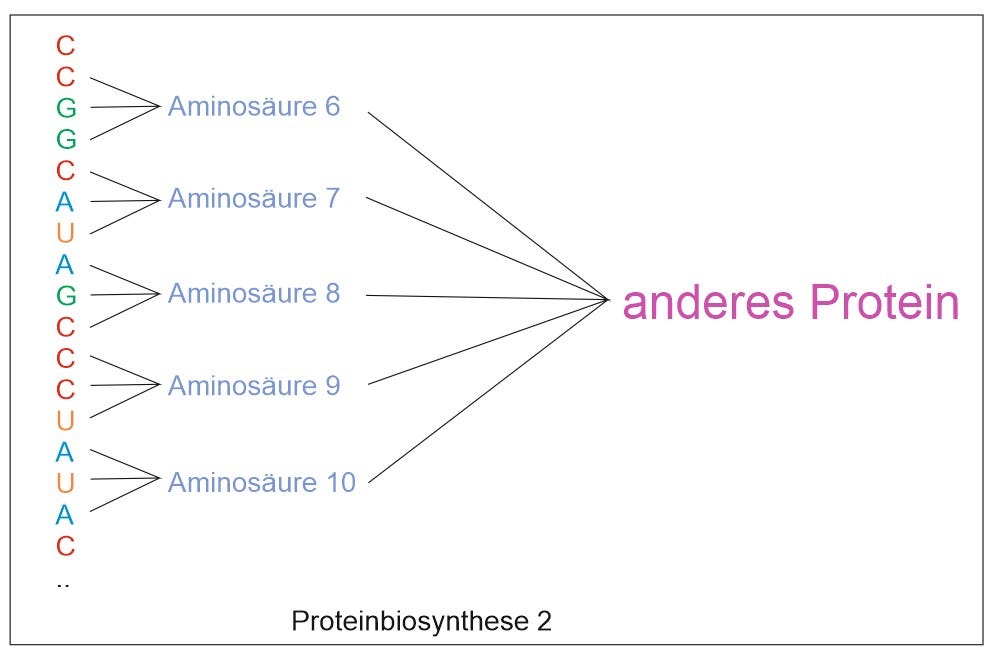
Protein biosynthesis simplified, Aminosäure = amino acid, anderes Protein = another Protein
The different triplet combinations naturally result in codes for other amino acids and thus also other proteins. The question is whether such other proteins are then known to the body and therefore useful for our metabolism. And this is precisely where a major problem lies, because nonsense proteins are then created that the body cannot use. In harmless cases, these proteins simply have no effect and are broken down, but in less harmless cases, they can massively disrupt our metabolism, form toxins or become amyloids (misfolded proteins), which can then trigger diseases such as Alzheimer’s and others.
How does a healthy body manage to avoid such errors? For example, by incorporating a start sequence and a stop sequence into this RNA. The start sequence is, for example, A-U-G, and for the ribosomes this means that the reading of the triple begins immediately afterwards. This ensures that errors do not occur, or only rarely.
Overall, it is all much more complicated than that, and there is not only mRNA, but also many other types of RNA, such as siRNA or asRNA, but this should suffice for understanding the effect of mRNA vaccines.
A major problem for the vaccine industry is how to preserve mRNA long enough for it to remain intact until it enters the cell from the injection, where it can start spike production and maintain it for as long as possible. And how does the mRNA actually enter the cell?
As already described, the mRNA is broken down after reading so that a protein is not produced indefinitely. To make the mRNA stable, a building block of the mRNA, namely uridine (= uracil plus sugar, see image above), has been replaced by a similar molecule, namely N1-methylpseudouridine, in the manufacture of the vaccines.
This simple step prevented the enzymes that normally degrade mRNA after use from functioning. The mRNA was now altered, so that it should no longer be referred to as mRNA, but rather as modRNA, i.e. modified RNA. This was now so stable that there are people in whom modRNA can still be detected in the body more than a year after vaccination.
Have you noticed that the name of one of the manufacturers of the vaccine broth bears this in its name? Mode RNA = Moderna!
The second problem with replacing it with N1-methylpseudouridine is that it can no longer be read by the ribosomes. When reading the triple, the pseudouridine is simply skipped, and reading continues afterwards. This is called frame shifting, and a study has shown that this actually happens. This also leads to incorrect proteins that can harm the body.
This modRNA, which enters the body and the cell via gene injection, leads to the mass production of spike proteins in the ribosomes (protein factories) due to its long shelf life. Once you understand this, you quickly realise that this vaccine cannot be eliminated, as it involves genetic manipulation. Whenever a ‘healer’ offers to remove this vaccine, you should run away, because it is obvious that this “healer” has not understood the principle of gene injection. You should also steer clear of ‘detoxification training courses’ or ‘detoxification conferences’. None of this has anything to do with science!
Unfortunately, there are clear indications that this mRNA can also alter our genes, and the possible effects on our organism cannot yet be fully assessed.
Lipid nanoparticles (LNP)
Small fat globules were used to get the modRNA through the cell wall and into the cell interior. Since the cell wall consists mainly of fats, it was possible for the fat globules to fuse with the cell wall and thus release the contents, namely the modRNA, into the cell interior. These fat globules are known as lipid nanoparticles, or LNPs for short. Unfortunately, extremely toxic versions were chosen (intentionally?), which, on the one hand, had not been approved for use in humans at all and, on the other hand, had not even been properly and completely investigated for their effects on the organism. What is certain so far is that the LNPs used in gene injection can cause severe inflammation in the body.
Other ingredients
In addition to modRNA and LNP, other ingredients have now been found in the gene injection that are not declared and officially have no place in such a vaccine, e.g. DNA.
DNA stands for deoxyribonucleic acid and is also genetic material, but it is significantly more durable and therefore significantly more dangerous. The consequences this will have for the organism are not yet known and have not been investigated. This DNA comes from the bacteria used to produce the modRNA, which were genetically modified. However, when harvesting the modRNA from the bacterial modRNA soup, the DNA of the bacteria or parts of it were not sufficiently removed. The effects this has on the human organism, including genetic modification or the development of cancer, are not yet sufficiently known. In any case, it is fundamentally possible that this foreign DNA could combine with our own genetic material, which also consists of DNA, and thus effectively reprogram our genes.
In the meantime, numerous other undeclared substances have been found in the various coronavirus vaccines, the effects of which on the organism are completely unknown.
I plan to publish a new chapter of this textbook approximately once or twice a week, time permitting. Each new chapter will be announced on my German Telegram channel https://t.me/coronawissenschaft.
Stay curious
Part 1 of the textbook can be found here: https://ralftillenburg.substack.com/p/lehrbuch-zur-behandlung-von-schaden
Mittlerweile wird auch jede Erkrankung mit Corona in Verbindung gebracht. Unglaublich. Seit meiner Corona Impfung leide ich auch an Fußpilz.
Einfach sich nicht spritzen lassen, hinterher ist immer gut zu jammern!